
From digital records to agentic care
Hospitals are digitised, yet clinicians, lab teams, billing staff and leaders still do the heavy lifting by hand. ICT Health adds one AI and agentic layer across the patient journey, for payors, providers and patients, in primary, secondary and tertiary care.
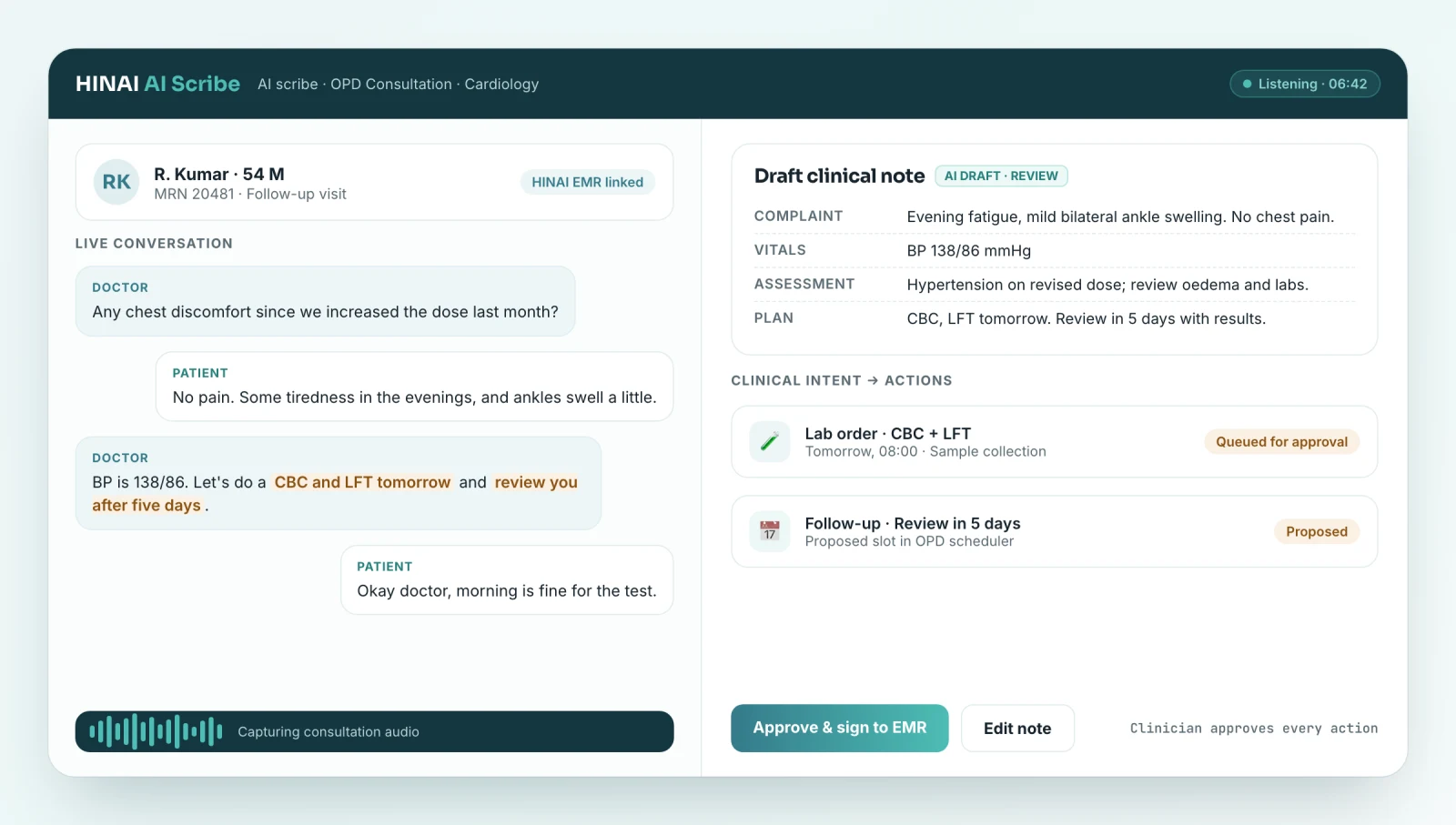
Illustrative AI scribe screen
What does agentic AI add to a hospital information system?
A hospital information system records what happened. Agentic AI acts on it: it drafts the clinical note, queues the lab order, prepares the claim or reorders the stock, then waits for a person to approve. HINAI stays the system of record; the AI layer does the repetitive work around it.
Five areas where ICT Health is already working with AI
Each one builds on the HINAI platform and the same orchestration layer, so a hospital can start with one and add the next.
AI scribe for OPD & IPD
The AI scribe listens to the consultation and drafts consultation notes, round notes and discharge summaries. It also pulls out clinical intent: "CBC and LFT tomorrow, review in five days" becomes a lab order queued for approval and a follow-up proposed in the scheduler.
- Works alongside your existing EMR, no rip-and-replace
- Clinician reviews and approves every note and order
- No second patient record to maintain
Intelligent laboratory and imaging
AI auto-verifies routine lab results within quality-control rules and adds decision support for validation, so technologists focus on the results that need a human. Imaging workflows connect AI diagnostic tools to the PACS / RIS worklist.
- Higher auto-verification, fewer transcription errors
- Supports NABL and ISO 15189 quality-driven labs
- Sample, testing, verification and reporting in one flow
Billing and claims agents
One billing orchestrator receives events from every HIS module and routes them to agents for eligibility, charge capture, pharmacy billing, pricing, claims and settlement. Claims agents check documents and mandatory fields, submit, then reconcile responses and remittances.
- Staff approve suggestions and work only flagged exceptions
- Document intelligence reads pre-auth letters and payer responses
- Payor-side tools for adjudication, eligibility and fraud, waste & abuse
Supply chain agents
Demand forecasting from admissions, surgery lists and seasonality drives replenishment, expiry control and stock transfers. Procurement and finance agents handle quotes, purchase orders and PO-GRN-invoice matching, with approval required above set limits.
- Implant and high-value consumable tracking
- Cold chain and oxygen monitoring
- Recall tracing to patients, wards and stores
AI dashboards for leadership
HIS, ERP, quality, HR and patient-feedback data feed one AI layer that produces role-based dashboards, flags anomalies and answers plain-language questions, so leaders see the hospital in real time rather than in month-end reports.
- Finance, operations, quality, HR and patient experience views
- Forecasts and automated alerts
- Command-centre view of beds, discharges and patient flow
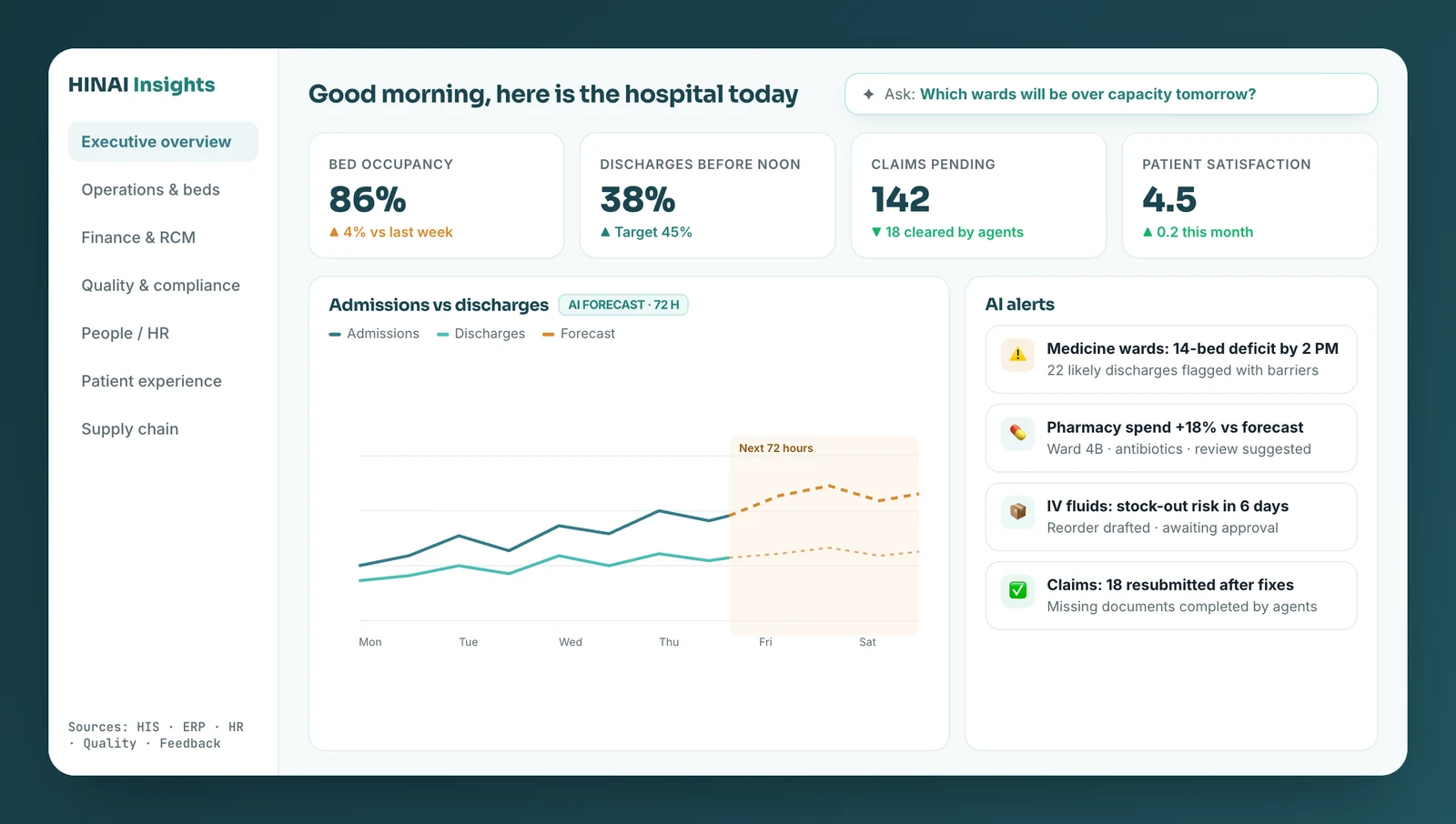
One view of the hospital, with AI that flags what needs attention
Bed occupancy, discharges, claims and patient experience in one place, a 72-hour admissions forecast, and alerts that come with a drafted next step.
A stock-out averted during a dengue surge
Hours instead of weeks of phone calls and paperwork. People step in only at approvals and exceptions.
- 1 Detect
Demand agent sees a rise in dengue admissions in the ED and projects IV fluid and platelet-kit demand.
- 2 Assess
Inventory agent forecasts a stock-out before the supplier lead time.
- 3 Rebalance
Surplus stock moves from low-use wards to the ED and ICU at zero cost.
- 4 Source
Procurement agent gets quotes from approved suppliers and ranks them.
- 5 Check
Compliance agent confirms vendor, product registration and budget.
- 6 Approve
Purchase manager gets a one-tap mobile summary to approve.
- 7 Execute
PO issued; supplier agent tracks dispatch and escalates delays.
- 8 Learn
Finance agent matches PO, receipt and invoice; usage retrains the forecast.
Illustrative scenario. The highlighted step is where a person decides.
Humans approve, agents execute
Clinicians sign off notes and orders; managers approve spend above set limits; claims staff work only flagged exceptions. Every agent action is logged for audit.
Document intelligence
OCR and AI read referral letters, lab reports, insurance forms and paper charts, extract the key fields and reconcile them to the HINAI record before they flow into billing, claims and analytics.
Patients and communities
WhatsApp and voice assistants in local languages, the patient mobile app, personalised discharge guidance and remote monitoring for care closer to home. Mobile apps →
Assess, pilot, then scale
AI maturity assessment
A baseline across seven pillars: strategy linkage, objectives, AI use, data, development, process and people, scored by function and site.
Pilot a priority use case
A 90-day pilot charter for the first use case, with scope, KPIs measured against your own baseline, and governance agreed up front.
Skill and scale
Role-based AI skilling for leadership, clinicians, operations and IT teams, then scaling the agents that proved their value across sites.
Need advice beyond HINAI? Our AI & Digital Healthcare Consulting team → works with any EMR, HIS or PACS.
AI & Agentic Care FAQs
Direct, factual answers to common clinical, deployment and integration inquiries.
What is agentic AI in a hospital?
Do we have to replace our EMR to use the AI scribe?
Who stays in control of AI decisions?
Where do hospitals usually start with AI?
Start with one AI use case, measured against your own baseline
Talk to ICT Health about an AI maturity assessment and a 90-day pilot on HINAI.